
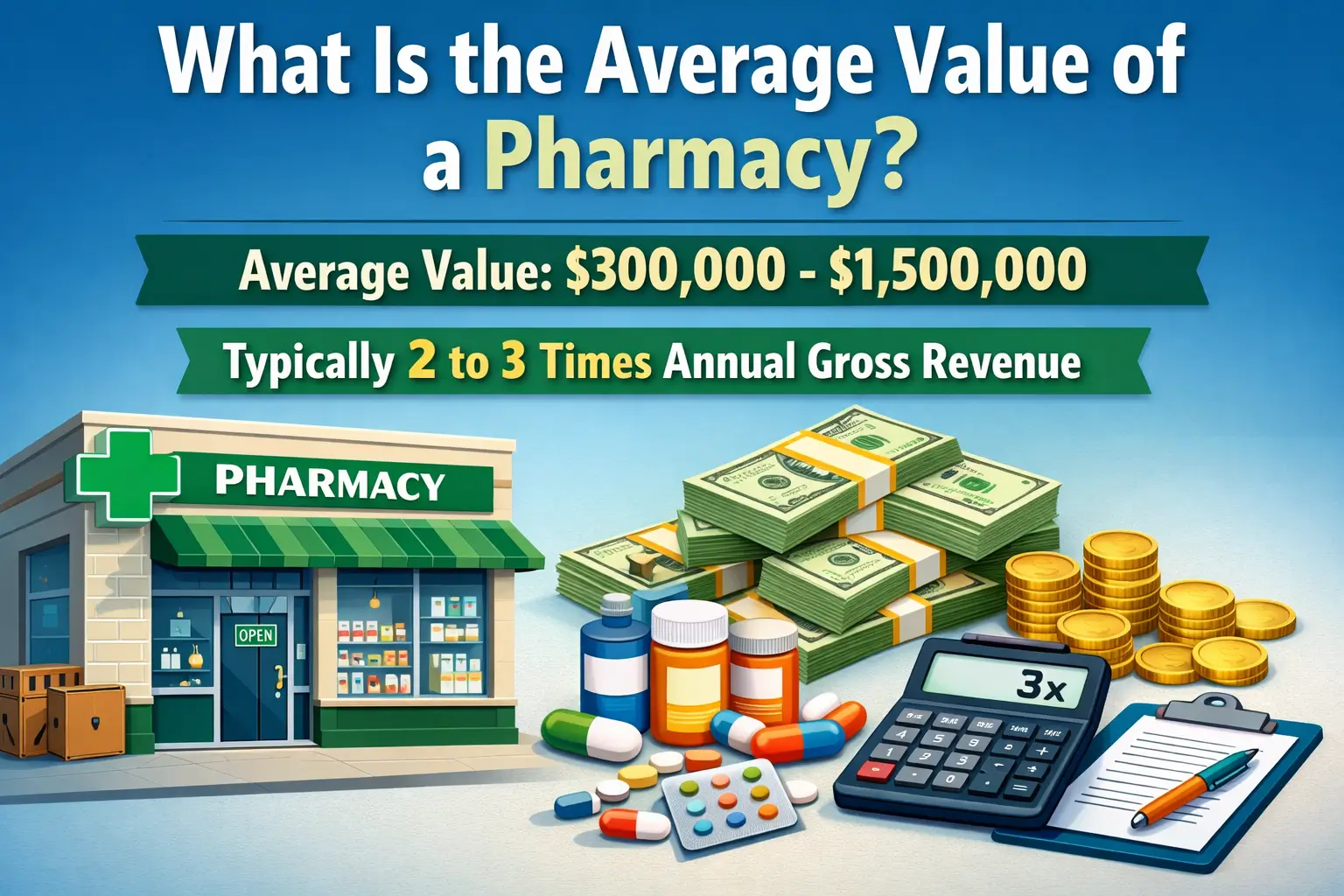
If you’re thinking about selling your pharmacy, one question comes up first:
What is the average value of a pharmacy?
The honest answer is simple. There is no fixed number.
However, there are clear benchmarks that can help you understand what your pharmacy might be worth.
Pharmacy value depends on profit, location, operations, and buyer demand. Let’s break it down in a way that actually makes sense.
Average Pharmacy Value and Valuation Range
Most independent pharmacies are valued based on a multiple of their annual profit, not revenue.
In general:
- Pharmacies sell for 2x to 4x their net profit (EBITDA or owner earnings)
- Some high-performing pharmacies can go higher
- Lower-performing or risky businesses may fall below this range
Example:
- Low range → $240,000
- Mid range → $360,000
- High range → $480,000+
If your pharmacy generates $120,000 in annual profit:
This is a general range, not a guaranteed price. The real value depends on how your pharmacy performs in the market.
Why Profit Matters More Than Revenue?
Many pharmacy owners assume higher revenue means higher value. That is not always true.
Buyers care about how much money the pharmacy keeps, not just how much it makes.
A pharmacy doing $3 million in revenue with thin margins may be worth less than a pharmacy doing $1.5 million in revenue with strong profit margins.
Profit drives valuation. Always.
Key Factors That Affect Pharmacy Value
No two pharmacies are the same. Buyers look at several factors before making an offer.
1. Pharmacy Profit and Cash Flow
Stable and predictable profit increases value. Inconsistent earnings reduce buyer confidence.
2. Pharmacy Payer Mix
Pharmacies with balanced insurance plans tend to perform better. Heavy reliance on low-margin plans can lower value.
3. Pharmacy Location and Lease Terms
A good location helps. However, high rent or a weak lease can reduce value quickly.
4. Pharmacy Prescription Volume and Growth
Consistent or growing prescription trends attract buyers. Declining numbers raise concerns.
5. Pharmacy Operations and Staff Stability
A well-run pharmacy with trained staff is easier to transition. Buyers prefer businesses that can run smoothly after the sale.
What Increases the Value of a Pharmacy?
Small improvements can make a big difference in price.
Focus on:
- Improving profit margins
- Cleaning up financial records
- Reducing unnecessary expenses
- Expanding high-margin services
- Maintaining strong compliance
Even a small increase in profit can significantly raise your final sale price.
What Lowers Pharmacy Value?
Some issues can push value down quickly:
- Declining revenue or profit
- Poor financial documentation
- Short lease terms
- Heavy dependence on one payer
- Compliance or licensing issues
Buyers see these as risks, and they price accordingly.
How Buyers Value a Pharmacy?
Buyers do not guess. They analyze.
They review:
- Financial statements
- Prescription data
- Expenses and margins
- Lease agreements
- Market conditions
Then they apply a valuation multiple based on risk and opportunity.
This is why two pharmacies with similar numbers can sell for very different prices.
Should You Get a Professional Valuation?
Yes. Especially if you are serious about selling.
Online estimates and assumptions can be misleading. A professional valuation gives you a clear, market-based number.
It also helps you:
- Set realistic expectations
- Identify ways to increase value
- Negotiate with confidence
👉 Request a Free Pharmacy Valuation
Final Thoughts
There is no single “average value” that applies to every pharmacy.
However, most pharmacies fall within a predictable range based on profit and performance. The better your numbers and operations, the higher your value.
If you want to understand what your pharmacy is truly worth, the best step is to get a proper valuation based on real market data.
FAQ’S
Most pharmacies sell for 2x to 4x their annual profit. The exact multiple depends on risk, stability, and buyer demand.
Yes. High-performing pharmacies with strong margins and growth potential can achieve higher multiples.
Buyers focus on profit. Revenue matters, but profit determines value.
Yes. Location, rent, and competition all impact how buyers evaluate a pharmacy.
Improve margins, organize financials, reduce costs, and stabilize operations. Small changes can increase value significantly.
It depends on your financial performance and market conditions. A valuation can help you decide the right timing.